

This is Part Two of my offering for the ‘Collectible Souls’ prompt, initiated by Katharine Kapodistria . As this is an ongoing project, I choose two minor deities to showcase.
If you have time this month (or the next), this is a really engaging challenge to participate in.
-
Of course, because this is me, there will be some ‘behind the scenes’ on the deity in question at the end, my reasoning for the story and suggestions for further reading,
in case you are interested in knowing more.
As always, mind the Content Warnings at the end.1
Enjoy.
The Counter
You pour the coffee at 2:47 AM. The trucker’s hands shake as he wraps them around the cup. He hasn’t slept in thirty hours. Hasn’t talked to another human being in six days. You can smell the desperation on him—tastes like stale tobacco and diesel fuel and the particular loneliness that comes from too many miles with nothing but highway reflectors and talk radio.
He sits at the counter. Third stool from the left. They always choose third or fourth. Close enough to talk, far enough to leave.
You refill his cup before he asks. The coffee pot is warm in your hand. The diner smells like bacon grease and floor cleaner and something older underneath—incense and prayers and four thousand years of travelers crossing your doors.
“Long route?” you ask.
He exhales like you’ve given him permission. “From Winnipeg. Heading to Houston. Then back up to Seattle. Then—” He stops. Rubs his face. “I don’t even know anymore. Just wherever dispatch sends me.”
You nod. Set the coffee pot down. Lean against the counter with your forearms on the laminate—the posture of someone with nowhere else to be, nothing more important to do than listen to a stranger at 2:47 AM in a highway diner that’s been here longer than the highway.
He starts talking.
About his daughter who won’t return his calls. About his ex-wife’s new husband who has a better job, better house, better everything. About the routes getting longer, the pay getting worse, the truck stops getting lonelier.
You listen.
Actually listen. Not the kind of listening where you’re waiting for your turn to talk. Not the kind where you’re checking your phone, watching the door, looking about for side work. The kind of listening that pulls words out of people like drawing poison from a wound.
He talks for hours. Doesn’t notice his coffee never empties. Doesn’t notice the clock on the wall has slowed down. Doesn’t notice he’s the only customer in the diner even though three other people came in, ate, paid, and left while he was talking.
Time moves differently at your counter.
When he finally stops—when the words run dry and he sits there breathing hard like he’s just finished a marathon—you pour him one more cup.
“That’ll be six dollars,” you say.
He pulls out his wallet. Leaves forty.
“Keep it,” he says. Looks embarrassed. “You—thank you. For listening. I needed—” He can’t finish. Doesn’t have words for what he needed.
You do. You’ve had ages to learn the vocabulary of hunger.
He leaves lighter. You watch him walk to his truck in the parking lot. He’ll be back soon. They always come back.
The forty dollars sits on the counter. You leave it there for now. Later you’ll add it to the others—the too-large tips, the exact change with extra bills folded inside, the credit card receipts with gratuity lines that say 50%, 75%, 100%.
Tribute disguised as generosity.
You wipe down the spotless counter. The laminate is scarred from decades of coffee cups, cigarette burns from before the smoking ban, knife marks from people who carved their initials into your altar without knowing what they were doing.
The door chimes. 4:13 AM. A woman in a sedan that’s seen better days. She sits at the counter. Fourth stool from the left.
“Coffee?” you ask.
She nods. Doesn’t meet your eyes. You pour. She wraps both hands around the cup like she’s cold, even though it’s June.
You wait.
She starts talking.
About her son who overdosed. About the rehab center that won’t take him back. About the job she lost because she kept leaving to deal with emergencies. About how tired she is. How she doesn’t remember the last time someone asked how she was doing.
You listen.
The words pour out of her like something rupturing. Like an infection lanced. She talks until sunrise. Doesn’t notice the coffee never cools. Doesn’t notice you never look away, never check your phone, never break attention.
This is how you feed.
Not on food. Not on money. On this—on the unburdening. On being witnessed. On the desperate human need to be seen by someone who isn’t looking at a screen, isn’t waiting for their turn, isn’t already thinking about the next thing.
She leaves thirty dollars for six dollars worth of coffee.
“Thank you,” she whispers. “I don’t know why I—I’ve never talked to anyone like that. I don’t even know you.”
You smile. “Sometimes that makes it easier.”
She’ll be back soon. They always come back.
The diner is always where they need it to be. The trucker swears it’s at mile marker 247, but the woman insists it’s at mile marker 198. They’re both right. You’ve been serving travelers forever. You know how to make sure the weary find you.
You count the money in the register at the end of your shift. Tips make up seventy percent of your income. The IRS would be suspicious if they looked closely. They won’t. You’ve been filing taxes for sixty years and nobody’s ever questioned the diner that’s been here since before the interstate was built.
Before the interstate, it was a truck stop.
Before that, a coaching inn.
Before that, a roadside shrine.
The location changes. The function does not.
You lock up at 6 AM. The morning shift arrives—two college kids who don’t understand why people sit at the counter for hours over a single cup of coffee. Who don’t notice that every single person who sits in stools three, four, or five leaves larger tips than the tables.
Your congregation doesn’t know they’re worshipping. They think they’re just stopping for coffee. Just taking a break from the road. Just talking to a friendly waitress who actually listens.
They don’t notice they leave feeling lighter.
They don’t notice they can’t stop coming back.
They don’t notice they haven’t checked their phones in hours.
They think they’re paying for coffee and food.
You know better.
They’re tithing. Every too-large tip. Every hour spent at your counter. Every confession whispered over cooling eggs and bottomless coffee.
Four thousand years ago, you served beer in a tavern to traveling merchants. You listened then too. Rose from tavern keeper to queen because you understood what people (and Gods) really hunger for.
Not food. Not drink.
Attention.
You drive home as the sun rises. In your apartment, you count the night’s offerings. Two hundred forty dollars in tips. Fifteen hours of confessions.
Three new regulars who will soon find their way back to the counter.
They always do.
-
On Kubaba
Kubaba (also spelled Kug-Bau or Ku-Baba) occupies a rare place in ancient Near Eastern history—one foot in the human realm, one in the divine.
She appears on the Sumerian King List as a tavern-keeper who became queen, the only woman recorded as a lugal (“king”) rather than a consort. Texts credit her with “making firm the foundations of Kish,” a phrase that connotes both civic order and sacred authority (Wiggermann, Birth in Babylonia and the Bible).
Her rise from innkeeper to ruler is usually framed as miraculous. The Weidner Chronicle recounts that Kubaba offered food and water to a fisherman and convinced him to dedicate his catch to the god Marduk; in return, Marduk “entrusted sovereignty over all the lands” to her.
In some traditions, Kubaba’s piety and generosity are the reasons she was elevated beyond mortality. Over time, her story blurred with local cult figures and, in later Anatolian contexts, she was worshipped as a minor divinity—a protective goddess of city walls, fertility, and hospitality whose name may prefigure that of Cybele, the great mother goddess of Anatolia (Posani, Epithets and Iconographic Attributes of Kubaba in Syro-Anatolian Sources).
This story imagines Kubaba’s afterlife.
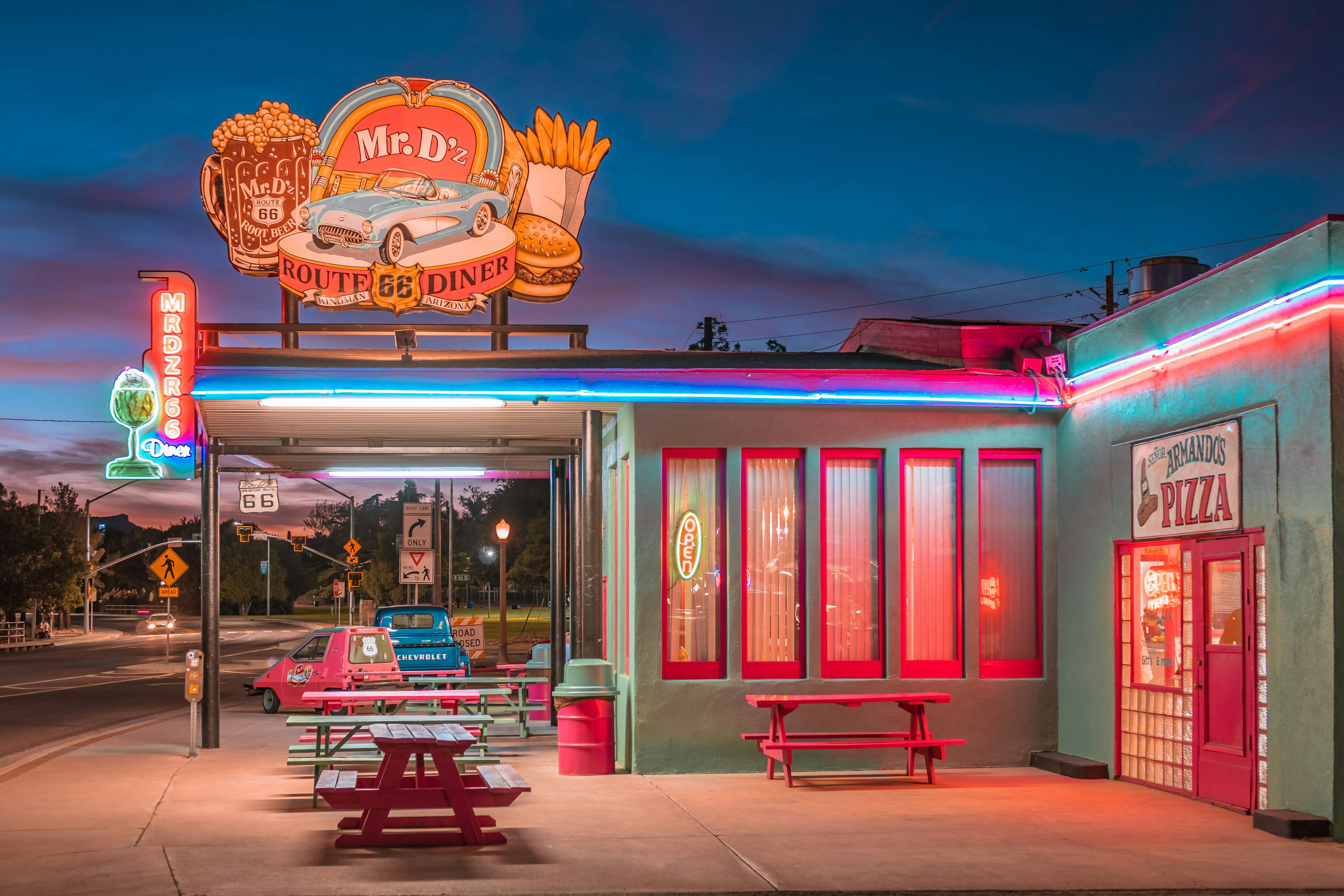
Not as a queen or a city goddess, but as something quieter and closer to her beginnings: the eternal keeper of a threshold. In The Counter, her shrine has become a 24-hour diner off an American highway. Her offerings are poured coffee and patient listening; her worshippers, the sleepless and the lost. The acts that once raised her to divinity—hospitality, attention, kindness without agenda—still sustain her.
The inversion here is temporal, not moral: the myth’s arc runs in reverse. Instead of ascending from mortal service to divine rule, she has stepped down from heaven to serve again.
Her immortality is no longer expressed through power but through presence. Every confession whispered at the counter, every too-large tip, every traveler who leaves feeling lighter—all are modern acts of devotion. What was once a temple is now a diner. What was once an offering of bread and beer is now gratitude and human attention.
Kubaba’s evolution from tavern keeper to goddess of hospitality makes her uniquely suited for reinterpretation in an age of loneliness. Centuries later, she still waits behind the counter—reminding us that sometimes, to be seen and heard is the closest thing to salvation we have.
References
Wiggermann, F. A. M. Birth in Babylonia and the Bible: Its Mediterranean Setting. Styx Publications, 2000.
Posani, Claudia. “Epithets and Iconographic Attributes of Kubaba in Syro-Anatolian Iron Age Sources.” Anatolica, 2023.
The Weidner Chronicle (trans. Grayson, Assyrian and Babylonian Chronicles). Toronto University Press, 1975.
Dexter, Miriam Robbins. “Ancient Felines and the Great Goddess in Anatolia: Kubaba and Cybele.” Journal of the American Oriental Society, 1990.
Hallo, William W. “Women in Mesopotamian Law and Society.” Journal of Cuneiform Studies, vol. 46, 1994.
© 2025 E.M.V. - writing as Morgan A. Drake. All rights reserved.“The Counter” depicts psychological manipulation and predatory behavior as a deity exploits human loneliness and vulnerability for sustenance. The story contains themes of isolation, social disconnection, family estrangement, and economic despair. Characters experience subtle coercion including time distortion, loss of awareness, and developing dependencies on attention that mirror addiction patterns, ultimately sacrificing other relationships and financial resources without realizing the extent of their exploitation. The narrative explores how desperate need for human connection can be weaponized, and features characters unknowingly losing agency and becoming bound to a supernatural entity through their own emotional vulnerability. This story may be triggering for readers dealing with isolation, loneliness, addiction recovery, or dissociative experiences.
I LOVE this. This is such a fascinating story. You always put so much energy into the topic you are writing. I'm walking away with an abundance of knowledge provided in a concise, compelling tale. I love this grey area this deity plays in: these people walk away feeling "better", but they are also revealing these stories somewhat against their will. They're offerings are unknown to them, but they have this beautiful benefit of being heard. I really enjoyed this 💜
This is great! I love that you found this wonderful myth and made it into something so beautiful and wholesome. I think, in the real world we live in, there are so many people crying out for this - just someone to listen impartially and non-judgmentally to everything piled up on their plates. This feels so authentic, even if it is about an immortal queen in a diner of no fixed location.