

The Columbia River restoration sites Sarah monitors are dying by degrees, and she is complicit in the careful documentation of their destruction. But something in the water is watching back, and it doesn't care about the traps of human compromise.
-
A version of ‘Compliance’ has been published in the Seattle issue of
Emerald City Ghosts Magazine
Sarah Hartley, Field Officer
NOAA Division 8B | Columbia Basin Restoration Rollback
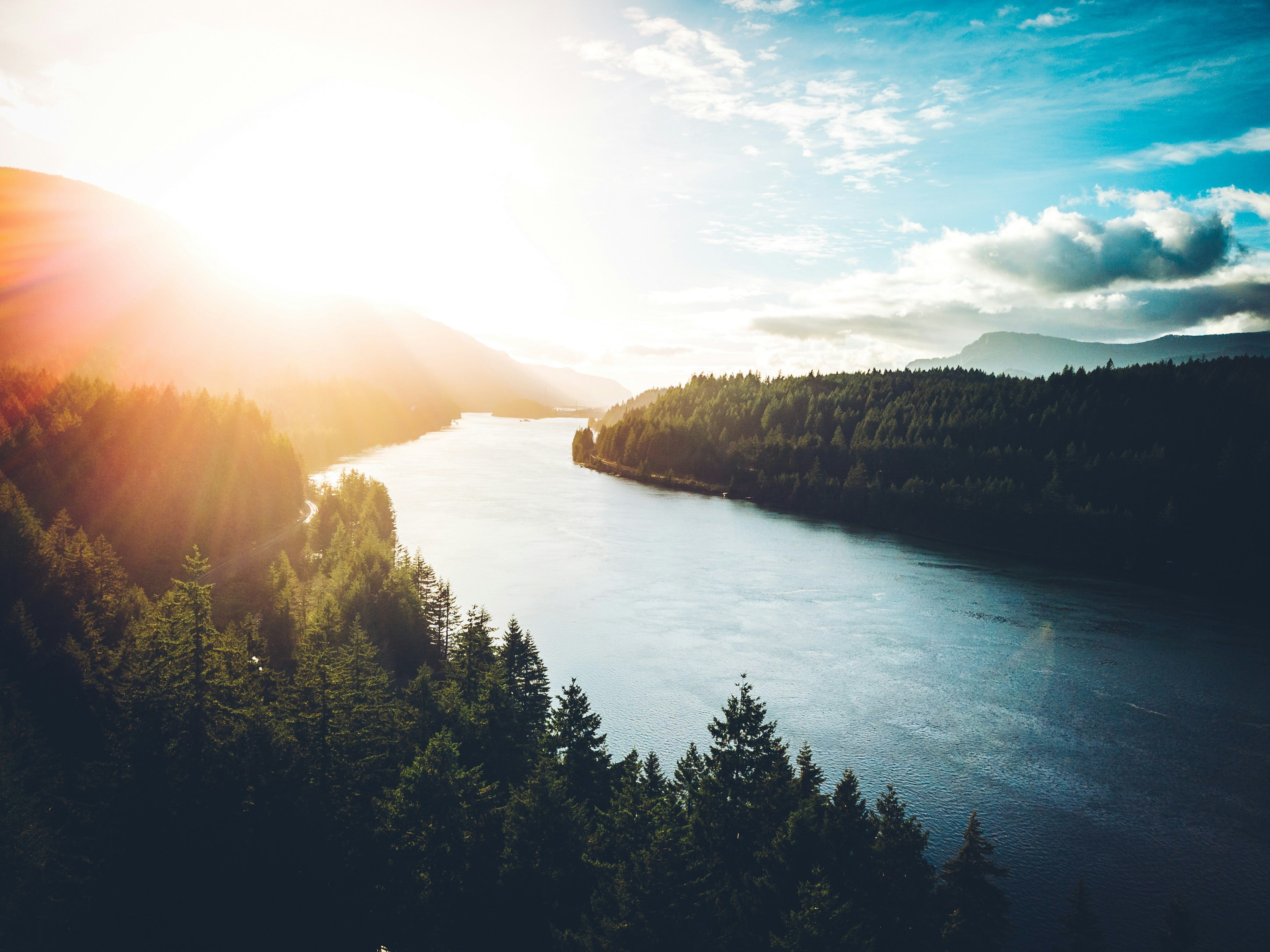
The Columbia runs past my boots with the steady indifference of federal policy. By Christmas, this water will hit concrete again.
I stand knee-deep in water that carved this channel before humans learned to remove dams, before we learned to build them again, watching the light fade over restoration beds that cost forty million dollars and seventeen years of lawsuits. Next month the concrete trucks arrive, and my report will explain why drowning salmon habitat represents sound fiscal management.
The bodycam on my shoulder blinks red, documenting my compliance with protocol. Water temperature forty-seven point three degrees, current slipping past like a cold hand smoothing gravel, dissolved oxygen adequate for creatures nobody cares about.
I record each measurement in my field notebook with the careful penmanship they insist on in the field after innumerable illegible reports, then again in the tablet, redundancy against legal chaos.
A call from my supervisor this morning, to remind me that we need to make sure the language won't trigger tribal litigation. We need the report to reflect that rollback won't negatively impact current environmental conditions. Clean documentation, he said. Bulletproof conclusions.
I wade deeper through water that tastes of snowmelt and alder tannins, following the restoration markers toward the spawning beds where coho returned last year in numbers that made hardened biologists weep.
Chest-deep now, the river presses its chill through neoprene and into my ribs. Every heartbeat feels borrowed. I tell myself to back out, but the water answers with another tug, as if it needs to show me what it's about to lose.
The world tilts without warning, gravel sliding under my boots, the sky flipping sideways, and an icy roar fills my ears, the sound of institutions collapsing.
-
I wake, kneeling in the shallows twenty yards downstream, water dripping from my hair and equipment, the taste of river bottom filling my mouth—sediment, minerals, something older, like drinking from the earth's memory.
My watch shows time has passed. Seven minutes missing, seven minutes of federal time unaccounted for, the kind of gap that generates questions I cannot answer without destroying what remains of my career.
The bodycam blinks steadily, still working, still recording, documenting whatever happened during my absence from consciousness. Uncaring of my drowning.
I should be hypothermic, should be calling for medical evacuation, should be following protocols for incident reports. Instead my lungs feel clearer than they have in years, almost cleansed, I have not breathed something this pure since I started living off office buildings’ recycled air.
My hands tremble, the current still pulls at my legs with that strange intentionality, and I shuffle back to shore wondering what kind of report I'll file about today.
The motel's chemical fog clings to the ceiling like a low tide. It settles on the roof of my mouth—bleach and cheap citrus—only revealing itself when I step back into the hallway and taste plain air again.
I connect the bodycam to my laptop and watch myself take measurements with bureaucratic precision, dictating notes about gravel composition and water quality. The footage remains crisp until six forty-seven, when it dissolves into static that hisses through my headphones like dead television channels, seven minutes of white noise followed by an image of me kneeling in the water, staring directly into the lens with an expression that doesn't belong on my face.
Me, and not me.
The timestamp shows six fifty-four, but there's additional footage I don't remember filming, though the footage is suddenly underwater, the image remains impossibly clear.
There’s breathing off frame, rhythmic and calm, the sound makes my chest tighten with sympathetic drowning.
I delete the file, my chest still heavy. Certain evidence serves no one's interests.
My pulse steadies as the trash icon changes.
Another call, this one at dawn while I'm drinking gas station coffee that tastes like disappointment. "How's the assessment going, Sarah?"
"A routine compliance check," I tell him, a familiar script. "Water quality within normal thresholds, restoration infrastructure catalogued per directive."
"Good. Let's keep the language clean on this one, neutral phrasing that confirms rollback implementation will cause no adverse ecological impacts. The tribes are already positioning for litigation, and we need this bulletproof."
I look at the screen, his voice keeps squawking from the speaker while coffee fog snakes across the dash. The steam inhales, exhales—calm and alive—while I mouth the lie he needs to hear, a rehearsal. "Any irregularities in the restoration status?" he asks, and I think of seven missing minutes, of breathing water, of currents that pull like hands. I hear myself say, "Nothing irregular."
"Excellent. Preliminary report by Friday. Keep it clean, Sarah."
After he hangs up I sit in the parking lot watching rain spot the windshield, thinking about the phrase that echoes in my mind, a prayer I'm not sure I believe. Nothing irregular.
Nothing irregular.
A lie told so often it starts to sound like the truth.
I once stood on a research deck and cried when the first coho returned to the Elwha. Who knows what’s left of me now.
I should be revising my draft, instead I return to the site against protocol, drawn by something I cannot name, some need to understand what I experienced before I document its irrelevance.
The restoration grounds look different in daylight, gravel beds extending upstream for nearly a mile, each stone positioned to create optimal flow conditions for salmon that return here by instinct older than human memory. Beautiful work, the kind that takes generations to perfect—scheduled now for drowning beneath concrete and steel.
I wade in slowly, alert for signs of disorientation, following the current until I'm standing above something that shouldn't exist—a fish trap constructed from carved bone and plant fiber, partially buried in sediment that predates any archaeological survey. Water flows around it in patterns that violate everything I learned about fluid dynamics, curling backward against the current as if the river itself is trying to avoid disturbing whatever lies beneath.
Sarah Hartley, someone says, my name spoken clearly from below.
I spin around but the riverbank is empty except for a great blue heron watching me from the far shore, motionless as driftwood. The backward-flowing water around the trap begins to emit a faint luminescence, and I step forward without deciding to, the river bottom dropping away beneath my feet as the water closes over my head with the gentleness of forgiveness.
Down. Drawn. Dragged. Drowning.
I should be drowning but my lungs work perfectly, drawing sustenance from the river itself, and the underwater world spreads before me in luminous revelation, light filtering through water beyond the physics I learned to trust.
They move everywhere around me, salmon so thick the water becomes something molten and alive, their bodies flowing in coordinated patterns that speak of intelligence older than human language.
People stand among them, wearing the river like clothing, patient as deep currents, scales catching impossible light, hair flowing like kelp, skin shifting between human and something other.
They don't speak with words but I understand them completely
You knew.
And the knowledge flows through me like the water I'm breathing, carrying the weight of every compromise I've made in the name of advancement.
They're right with the terrible accuracy of natural law.
I knew. The data was unambiguous, the projections as reliable as gravity—remove the dams and salmon return in numbers that make biologists weep, build them again and populations collapse within a generation. Simple cause and effect in honest numbers.
But knowing and witnessing exist in different realms of moral responsibility.
Here, in this cathedral space where water meets conscience, seeing the ancient patience in their eyes, the understanding, the forgiveness and the deep deep sadness, feeling the accumulated weight of all the reports I've sanitized, all the meetings where I chose loyalty to the bottom line over truth—the smallness of my behaviour overwhelms me, drowning.
Not just complicity but the particular cowardice that comes with expertise, the dismissive betrayal of those who know better and do worse.
And you let it happen again,
It’s said without speaking, and one of them extends something toward me, a hook I know it’s carved from salmon bone, strung with red thread the color of spawning flesh.
Remember, it, she, they tell me.
Looking away is still a choice.
The water darkens at the edge of my vision. I'm drowning after all.
I wake on the riverbank, soaked and shivering, another hour lost to whatever happens when reality cracks open and collapses on itself.
A pointed weight shifting against my side tells me the salmon-bone hook is in my pocket, solid evidence—or maybe a witness. I need to look, to know. I can’t look and be certain.
I walk upstream following my own wet footprints, past a salmon carcass lying on the gravel, silver sides already dulling, but the eyes are wrong—human, and they follow me.
I look away.
The federal building's fluorescent hum burrows into my temples.
My cubicle waits exactly as I left it—regulation desk, regulation computer, regulation photograph of a regulation landscape that never existed. I open the compliance report template and watch words appear on the screen: "Assessment conducted September 15-16, 2025. Water quality parameters within acceptable ranges. No adverse ecological impacts anticipated from restoration rollback. Recommend proceeding with dam reconstruction as scheduled."
A rehearsed lie.
My cursor hovers over the send button, my hand finds the hook in my pocket. It pulses faintly under fluorescent lights, slightly damp despite being carved from dry bone. Remember.
It’s alien in my grip, and the most real thing in the world right now.
I delete the paragraph and type something new: "Additional monitoring protocols recommended prior to reinitiation of construction activities. Anomalous environmental conditions require further assessment."
Still not the truth, still not brave enough to write what I witnessed–and who would believe me anyway, but enough to delay, to buy time, to force someone else to make the choice I can't.
Looking away is still a choice.
A heavy splash echoes from the break-room sink—thick, like a salmon breaching wood. I can feel my socks cool, as if the carpet has learned to seep. No one lifts their heads. Keyboards keep tapping, a swarm of dry clicks above the hush of rising water.
You notice things when you start looking—a fish scale on the copier tray, wet footprints leading from the elevator, the persistent drip from the water cooler that sounds exactly like a salmon's tail slapping stone.
Sarah Hartley
My name rises from every glass of water in the building, eternal like the tide, and the cursor blinks and awaits my choice, while I tuck the salmon-bone hook back into my pocket, listening to the sound of something vast and patient waiting for me to–
© 2025 E.M. di V. - writing as Morgan A. Drake. All rights reserved.